Traces
John P. Hastings & Benjamin Mayock
released by Pickled Peach Press
April 17, 2026
https://hastingsmayock.bandcamp.com/album/traces
private streaming link: https://on.soundcloud.com/bMzn6aibPEaTZ5UYmq
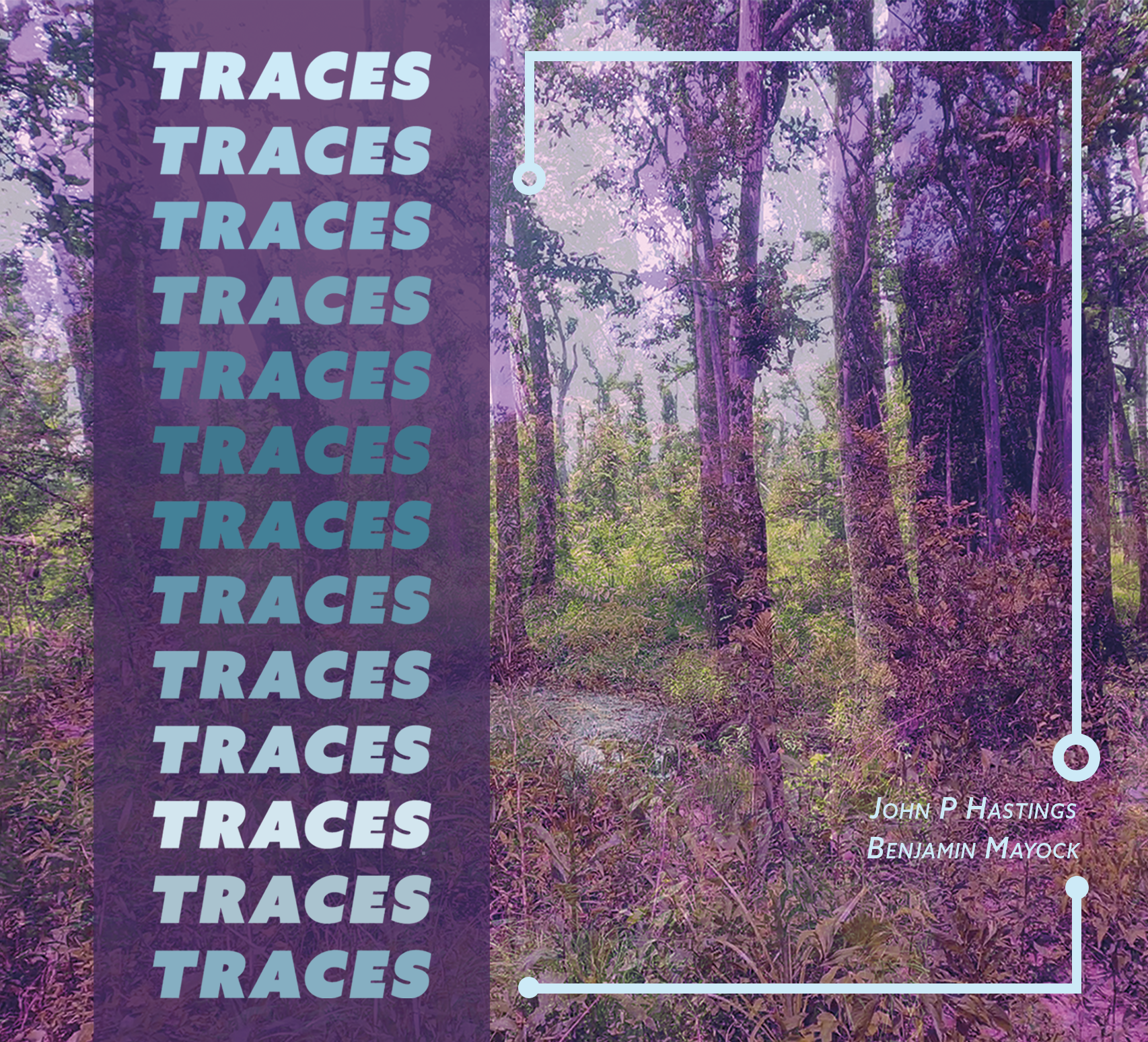
The Natchez Trace is a primeval footpath running from roughly Nashville, TN to Natchez, MS. Originally used by fauna (possibly to find salt licks), it was codified into a path by ancient Native Americans. Using this line through the landscape, John Hastings and Benjamin Mayock have fashioned an album that meditates on our shared stories and histories.
Traces is a radical reframing of our American landscape and how those lands affect its inhabitants. The album focues on three separate and connected, time streams: archaic North America circa 2000 BCE; the colonialist-era, as seen through the eyes of a doomed, possibly syphilitic, explorer; and the 20th century, particularly during the 1960s. These eras are collapsed together, a concatenation of peoples and times into a singularity that roils and pulses. The land itself is a character in this drama: the fertile ground known as the Black Belt Prairie is a place for humans to congregate, utilize, and eventually foul.
The CD / digital release captures performances in situ, from old churches, first-thought-best-thought phone demoes, multi-tracked and layered interviews (inspired by Glenn Gould’s seminal Solitude Trilogy of proto-podcast documentaries), conversations with new found friends, recordings made on the path itself, and much more. The center piece of the album is a group of field recordings taken from John and Ben forming ‘clouds’ of piano chords (in an homage to LaMonte Young’s Well Tuned Piano) at a 19th century church in Rocky Springs, MS. All the live recordings have been kept as close to their source as possible with very little editing and sonic manipulation.
In the studio, John and Ben bowed a grand piano, adding to the sonic resonances of the field recordngs. Stories written on the road were recorded using a vintage Nagra tape recorder and interpolated into the sonic mix.
Together with the album, a photo book from the journeys will also be released. These photographs, ephemera, and traces, were collected and constitute a visual record of the album.
More information: johnphastings.org/traces
Instagram: @johnphastings / @benjaminpmayock
Thanks to: Andrew Smith, Indexical, Burlington City Arts, JoVonn Hill at Mississippi State University, Shannon222, Roosevelt, Hale County Library, Rural Studio
Mastered by A.F. Jones at Laminal Audio, Tracyton, WA.
Recorded on location in Tennessee, Alabama, and Mississippi, U.S.A. and in studio at Community of Sound, Burlington, VT, 2021 - 2024.
Bios:
John P. Hastings is an artist and musician focused on exploring ecology, geography, and human societies. He works across media, using performance, video, installation, photography, and sound recording. He also likes to read books.
Geography and deep research form a large part of his artistic practice. Specific sites become a starting point to engage in a dialog between peoples as well as the landscape we live. The historical record emerges as a place to question ourselves, the ideas that have been passed down to us, and how we can function with the weight of those histories upon us. Trained as a musician and composer, Hastings uses sound and audio as major through lines in all his works.
His collection, The Former World, was previewed by The Industry and wildUp in Los Angeles, CA as part of their FIRST TAKE Series in 2017. The work, based on the writings of John McPhee and Robert Smithson, utilizes video, audio recordings, live performers, and electronically manipulated roadside debris, to engage with how humans see the environment and how that environment records our presence.
Cloudsplitter, an outdoor performance work for brass ensemble, used the story of radical abolitionist John Brown to draw parallels between our current era and some of the most consequential in our nation’s history. A Civil War-era march and an 18th Century hymn are recast and re-composed to create the musical materials for the performance with the costumes and movements of the performers functioning as visual corollaries to these themes.
He has had performances at a variety of venues and festivals including the River to River Festival (New York, NY), Hammer Museum (Los Angeles, CA), REDCAT (Los Angeles, CA), Issue Project Room (Brooklyn, NY), Center for New Music (San Francisco, CA), Roulette Intermedium (Brooklyn, NY), Festival of New American Music (Sacramento, CA,) Other Minds Festival 17 (San Francisco, CA), Itinerant Interludes (Berlin, Germany), Make Music New York (New York, NY), the LUMEN Festival (Staten Island, NY), and many more.
His compositions have been featured on the releases Songs Crystals Drone (2023), VVaves of VVagner (2021), minimal music (2016) and chamber music (2009). Book releases include, john p. hastings : scores & drawings 2010, published by Middlepress in 2010, and The Former World published by Pickled Peach Press in 2022.
He is an active performer, playing a variety of instruments in productions by Object Collection, OZET and others while also hitting the stage at rock venues with Wormburner, amongst others.
Benjamin Mayock is a composer and sound artist living in Northern Ireland. Ben’s compositions strive to find the intersections between frequency, time and collected material. Text, music and sound captured from lakes, rocks, forests and fields make up the source material for Mayock’s work.
After graduating with a BFA from Bennington College with a focus in studio sound recording, Benjamin obtained an MFA from the California Institute of the Arts. At CalArts he studied under Mark Trayle, Marc Sabat and Michael Pisaro. In 2008 Ben traveled to Amsterdam for a month-long residency at S.T.E.I.M. where he developed a series of sensors that transformed his prosthetic leg into a MIDI controller.
A lifelong outdoorsperson, Ben captures sounds and sights from his rural surroundings. Using field recording and photography to expand upon his compositions, Mayock strives to record, perform and present a contrivance that reminds the listener of an environment they’ve never seen but, seemingly, know well.